
In this article
- Which George Orwell book fits your mood?
- 1. Animal Farm: my first pick for most readers
- 2. Nineteen Eighty-Four: the darkest starting point
- 3. Down and Out in Paris and London: the best nonfiction entry
- 4. Homage to Catalonia: war seen from close range
- 5. The Road to Wigan Pier: reporting with an argument attached
- 6. Burmese Days: empire inside a social circle
- 7. Coming Up for Air: the quiet book about change
- The writer behind the name
- A reading order that does not feel like a course
- What other readers find beyond the two famous novels
- Choosing an edition
- Where I would begin
George Orwell books can sound like homework before you open them. His name gets used in rows about politics. His best-known titles turn up on school lists. Yet his books are full of concrete things: hard work, bad meals, lost sleep, fear, and the wish to have a private life.
The right place to start depends on what draws you in. Do you want a short novel? A war memoir? A close view of life with very little money? George Orwell wrote all three. You do not need to begin with his first book, and you do not need to read his novels in date order.
I put ease of entry first in this guide. These seven books show different sides of the writer. The order is a reading path, not a claim that one form of literature is worth more than another. I have kept major plot endings out of the summaries.
Which George Orwell book fits your mood?
| Book | Choose it for |
|---|---|
| Animal Farm (1945) | A brief political fable with a clear plot |
| Nineteen Eighty-Four (1949) | A dark novel about truth and state power |
| Down and Out in Paris and London (1933) | Work, hunger, and life with little money |
| Homage to Catalonia (1938) | A personal account of the Spanish Civil War |
| The Road to Wigan Pier (1937) | Working-class life and a fierce political essay |
| Burmese Days (1934) | A novel about empire and social pressure |
| Coming Up for Air (1939) | Memory, middle age, and a changing England |
1. Animal Farm: my first pick for most readers
Best for: a short first step into George Orwell's fiction.
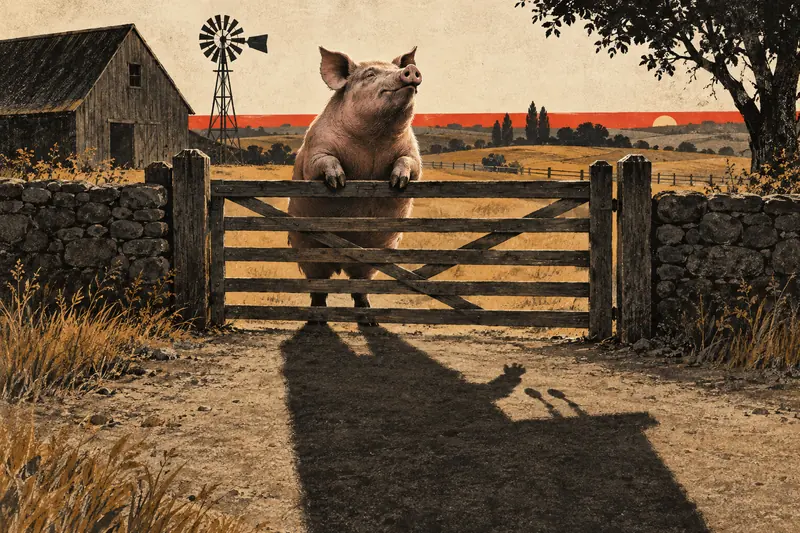
In Animal Farm, farm animals rise against their human owner. They want a fairer life. The new rulers then begin to bend the rules. A story that starts with hope grows into a study of how power protects itself.
Published in 1945, Animal Farm is an allegory of the Soviet regime. An allegory is a story whose people and events stand for ideas or events beyond the plot. You can follow the animals without knowing every link to Russian history. Knowing those links adds depth, but the story should come first.
I recommend Animal Farm because its shape is so clear. You can watch a promise change. You can see how a slogan makes a hard fact easier to hide. Orwell does not need a long speech to show the gap between what leaders say and what they do.
The simple form is also its limit. These animals do not have the full inner lives you may want from a long novel. If you prefer messy motives and slow changes in a character, Animal Farm may feel too neat. Its force comes from compression.
Read it once for the story. Then go back to the rules and speeches. Ask who can read, who can question a claim, and who gets to say what happened yesterday. Those are useful questions well beyond the farm.
Read next: Nineteen Eighty-Four expands the questions of memory and control. Homage to Catalonia takes you to the war experience behind part of Orwell's distrust of Stalinist politics.
2. Nineteen Eighty-Four: the darkest starting point
Best for: readers who want a longer novel about power over daily life.
Nineteen Eighty-Four, often sold as 1984, follows Winston Smith in a state ruled by the Party. He works with records of the past. His private doubts put him at odds with a system that claims the right to define truth.
The novel was published in 1949. It is not a forecast with a deadline. Its lasting question is how much room remains for thought, love, and trust when power reaches into all parts of life. The watching matters, but so does the damage done to language and memory.
That makes Nineteen Eighty-Four more demanding than Animal Farm. Its world is bleak. Some passages pause the action to explain the system. Violence and coercion are central to the book, so I would not choose it for someone seeking a light first encounter with Orwell.
My reason to recommend it is the link between public and private life. The danger does not stay in a distant government office. It reaches a room, a friendship, a thought. The novel gives a human scale to ideas that can otherwise feel abstract.
Pay close attention to Winston's job. What happens when records can be changed and no trusted copy remains? That question is more precise than calling every disliked policy “Orwellian.” A good comparison should name the feature it shares with the book.
Read next: Animal Farm offers a shorter account of changing rules. For the writer's own experience of false political claims, choose Homage to Catalonia.
3. Down and Out in Paris and London: the best nonfiction entry
Best for: readers drawn to work and ordinary life.
Down and Out in Paris and London was George Orwell's first book, published in 1933. It draws on his life in both cities. Kitchen work in Paris and life among poor and homeless people in London give it two distinct parts.
The strongest reason to start here is how direct the subject is. A meal costs money. A bed costs money. Work can use up the hours and strength you need to look for a better job. Those facts make poverty harder to dismiss as a simple failure of effort.
Orwell's nonfiction can be blunt and funny, with a sharp eye for the rules that people accept without much thought. That voice gives this book a different pull from his famous novels. The pressure comes from daily needs more than a large plot.
But this is one writer's account, shaped into a book. It is not a complete record of poor people in either city. Orwell's own background and route through hardship matter. I would read him as an alert witness whose choices and blind spots deserve attention too.
Some language and attitudes also show the period. An older book can challenge one form of prejudice while carrying another. You can value what the writer sees clearly without accepting all his judgments.
Read next: The Road to Wigan Pier moves from a close account of need toward a more open argument about class. If you want a later history built around several lives, our review of The Warmth of Other Suns offers another route.
4. Homage to Catalonia: war seen from close range
Best for: readers who want to understand Orwell's politics through experience.
George Orwell went to Spain in 1936 and joined a militia fighting against Franco's forces. Homage to Catalonia, published in 1938, recounts his time in the Spanish Civil War, including the front and political conflict in Barcelona.
It is a war memoir with long stretches of waiting and discomfort. That is part of its value. War is not only a sequence of great charges. It is also cold, confusion, poor gear, and people trying to work out what is happening.
The political sections take more effort. Groups that share an enemy do not share all their aims. The divisions among the left are essential to what George Orwell learned in Spain. A short note on the main parties can help you follow those pages.
I would keep one limit in view: Homage to Catalonia is an account from a participant with a clear position. It is not a neutral history of the whole Spanish Civil War. Its close view is the reason to read it, but also a reason to read beyond it.
The book helps explain why a socialist writer could be so fierce a critic of Stalin and Communist power. Those positions are not at odds. Orwell's belief in a more equal society did not make him willing to excuse lies or repression by people who used its language.
Read next: Return to Animal Farm with that tension in mind. Then notice how Nineteen Eighty-Four treats the control of the past.
5. The Road to Wigan Pier: reporting with an argument attached
Best for: readers interested in class, work, and the writer's own assumptions.
The Road to Wigan Pier was published in 1937. Its first part looks at working-class life in northern England. Coal mining, housing, and the strain of low income make the subject concrete.
The second part changes gear. Orwell writes about class prejudice and the problems he sees within socialism. It can feel like two books in one. Expect that shift and it becomes a useful contrast: first the living conditions, then an argument about how people respond to them.
This is the George Orwell book I would choose for a reader who likes to argue in the margins. The writer has strong opinions. Some strike hard; others reveal the habits of his own class. The point is not to grant him a pass because he is famous.
Ask whether each broad claim follows from the scene or fact before it. Where does observation end and judgment begin? The Road to Wigan Pier gives a reader plenty of chances to practice that distinction.
The book's split form may put off readers who want one smooth story. Down and Out in Paris and London is an easier first choice for them. The Road to Wigan Pier suits those who want the political argument stated more openly.
Read next: Homage to Catalonia shows those ideals meeting the strain of war. Readers interested in how a modern policy book builds a case can also turn to our review of The New Jim Crow.
6. Burmese Days: empire inside a social circle
Best for: readers who prefer a social novel to a fable.
Burmese Days was Orwell's first novel. The first American edition appeared in 1934; the British edition followed in 1935. Its setting draws on Burma, where he had served in the Indian Imperial Police.
The story follows John Flory, a timber merchant within a British colonial circle. Friendship, status, race, and the wish to be accepted shape the plot. The European Club becomes a small space in which the larger rules of empire can be seen.
What makes this novel worth reading is the pressure of belonging. A person may know that a system is cruel and still fear the cost of defying the people around him. That gap between private doubt and public courage gives the story its bite.
Burmese Days is a criticism of imperialism, but it still asks us to spend much of our time within a colonial viewpoint. The book contains racist speech and attitudes. Reading those passages critically is part of reading the novel.
I would choose it after Animal Farm if you want a fuller cast and more social detail. I would hold it for later if you mainly want the clean shape of Orwell's best-known political fiction.
Read next: Coming Up for Air turns the view toward England and another man who feels trapped by the life around him.
7. Coming Up for Air: the quiet book about change
Best for: readers drawn to memory, home, and middle age.
In Coming Up for Air, George Bowling leaves his daily life to revisit the town where he grew up. Published in 1939, the novel carries the fear of another world war alongside the wish to return to an older England.
This is a less direct way into George Orwell's political ideas. There is no farm revolution or all-seeing Party. Instead, a man wants space from his present life. His memories offer a promise that the real place may not be able to keep.
I like this choice for readers who prefer an uneasy question to a clear moral. When we miss a place, do we miss the place itself, or who we were there? A return trip cannot settle that as neatly as we might hope.
The slower pace is the chief risk. A reader expecting the plot pressure of Nineteen Eighty-Four may find the memories a detour. Someone who enjoys a voice, a town, and the feeling of time passing may find that they are the point.
Read next: Nineteen Eighty-Four turns the fear of a lost private world into a far harsher vision. Down and Out in Paris and London offers a return to the physical detail of daily life.
The writer behind the name
George Orwell was born Eric Arthur Blair in 1903 and died in 1950. He used a pen name for the books that made him known. Eric Blair and George Orwell are the same person, not two writers with similar politics.
His career crossed several kinds of work. He served in the Indian Imperial Police in Burma, became a journalist and novelist, went to Spain, and worked for the BBC during the Second World War. He also became literary editor of the newspaper Tribune. The Orwell Foundation's biography sets out that path.
The background helps connect the books. Burma shaped his view of empire. Poverty and work fed his nonfiction. The Spanish Civil War sharpened his concern with political lies. But a life event does not explain every line in a novel. Fiction has its own shape.
Orwell was a democratic socialist and an opponent of totalitarian rule. It is misleading to treat his criticism of Stalin as support for every position on the political right. It is just as misleading to use his socialism to soften his criticism of Communist repression. His writing asks for closer reading than either shortcut allows.
A reading order that does not feel like a course
For fiction, I suggest Animal Farm, then Nineteen Eighty-Four, then Burmese Days or Coming Up for Air. You move from a short fable to a large invented system, then toward the less famous social novels.
For nonfiction, start with Down and Out in Paris and London. Follow it with The Road to Wigan Pier, then Homage to Catalonia. Daily need leads into class argument, then into the clash between political ideals and war.
For one book group, I would pair Animal Farm and Homage to Catalonia. Ask how the writer's account of Spain changes the way you read the fable. Keep differences in genre in view: a memoir makes claims about events; a fable builds meaning through an invented plot.
If you want to trace the career by publication date, use the dates in the table. You do not gain a reading prize for doing so. A book that holds your attention is a better next choice than a date you feel obliged to obey.
What other readers find beyond the two famous novels
In an r/books discussion of Orwell's less-read work, the original poster praises the vivid detail in his nonfiction. Other readers make the case for Homage to Catalonia and Down and Out in Paris and London. The thread also contains a useful disagreement about Coming Up for Air: some value its nostalgia, while another finds it dull.
Those comments are individual views, not a poll of all Orwell readers. Still, the disagreement helps frame a choice. A slow book about memory can be a reward or a frustration, depending on what brings you to it. That is more useful than a star score with no explanation.
Choosing an edition
For a first reading, choose a clear, complete edition with type you can read comfortably. An introduction and notes can help with older terms and political groups. Read the novel first if you want to avoid spoilers in the introduction.
Check the contents of a collection. A volume of essays is not the same as a set of complete novels. A study guide is not the original text. For audio, check that the recording is unabridged if you want the whole book.
Page counts differ by edition, type size, and added material. Do not use them alone to judge whether a book is complete. A library edition is a good way to learn which part of Orwell's work you want on your shelf.
Where I would begin
My first pick remains Animal Farm. It is short enough to enter easily and precise enough to reward a second reading. If fiction rarely holds you, choose Down and Out in Paris and London instead.
Then follow the question that stays with you. How does power change a promise? What does poverty do to a day? What can a writer know from taking part in a war? George Orwell's books offer several doors into those questions. You only need to choose the first one.